“If I were asked what the main contemporary conflict is, I would say: it is the conflict between civilisation and the eternal question of spirituality.”
Ivan Vyrypaev [1]
Ivan Vyrypaev is one of the most frequently staged contemporary Russian playwrights across Europe. A core figure of the New Russian Drama — Novaia Drama [2] — his dramaturgical voice (alongside his direction of many of his own plays and three screen adaptations he has signed himself) is opening up a path that is increasingly being followed. He is an artist who does not shy away from politicising his artistic life, understanding that the creative process is, first and foremost, a process of production with material consequences, as shown by the recent letter to Russian theatres published on his personal website [3]. His texts take the spiritual pulse of Western societies, examining our persistent questioning of the meaning of our lives and the personal crises that emerge from it. How does he explore this in Unbearably Long Embraces? And what kind of theatrical play does he propose?
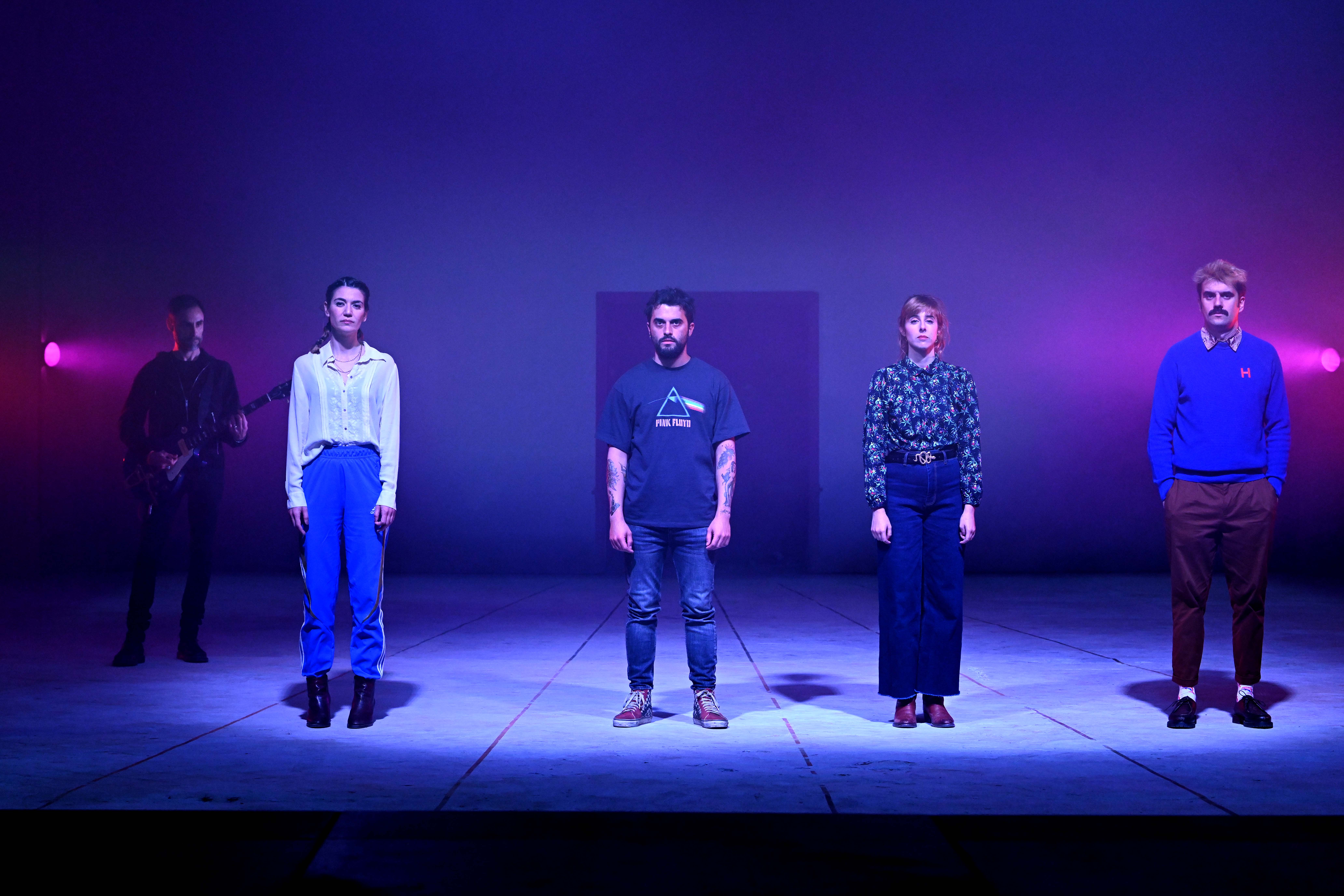
As José Gabriel López Antuñano [4] notes, Vyrypaev’s plays usually begin with a relatively concrete fable. They tell the stories of characters, their adventures, and the chain of cause and effect that drives them. But within these plots, there are always moments of distortion, both in content and in form. “With its roots buried in realism, the author rises above the social context to project the action towards the search for human transcendence, the common denominator of his dramaturgical work.” [5]
Unbearably Long Embraces contains not only the lives of four characters moving between two cities, but also the appearances of a strange voice that changes the course of things. The realism of the fable dissolves into a more lyrical realm. For Vyrypaev, the fable becomes secondary and, as he himself puts it, serves “only as a pretext to convey a real reflection and emotion. The theme is more important than the fable.” [6] In this sense, the fable serves as metaphor, image, support — a concrete vehicle for the theme: the question of spirituality.
What stands out in Unbearably Long Embraces in relation to this theme, as Ferran Utzet highlights in his director’s notes, is that it does not simply offer a fatalistic diagnosis of our fragmented and disoriented societies, but rather introduces this strange voice to open up the possibility of salvation. As if turning the cry “this is a disaster!” into a question: “and you, what are you doing with your spirituality?”
KRYŠTOF: I’m alive — Kryštof whispers, and weeps. I’m alive — Kryštof whispers, and smiles. I’m alive — Kryštof whispers, and weeps. I’m alive — Kryštof whispers, and the black serpent transforms into an ‘Oh my God, I didn’t know I could feel such tenderness inside me.’ And now millions of Kryštof’s cells rush towards millions of Monica’s cells. And now they bind to one another in unbearably long embraces. Oh my God, I didn’t know I could feel such tenderness inside me, Monica — Kryštof whispers. [7]
This way of approaching the question of spirituality doesn’t merely burden the spectator with critical insight or warnings against nihilism. Instead, it places them at the heart of a revelation — such that they leave the theatre with a question pending: “what do I do with this?” It’s this unresolved task that makes this play contemporary. Indeed, if it were only a diagnosis of the spiritual emptiness we’re living through, it would certainly be dealing with a relevant topic, but what kind of intervention would it be making? Wouldn’t we leave the theatre just as we came in? That is, simply aware of what we already know? The text is contemporary not because it has been written recently by a living author on a current issue, but because, if it has its intended effect, it shakes reality through a real event: a theatrical revelation, a spiritual activation. This shock no longer depends solely on the fable or the theme, but on its form. In this regard, Vyrypaev states that contemporary theatre “does not depend on choosing a current topic; [rather, it is] a theatre capable of finding a contemporary means of communication. The theme matters little.” [8] We must therefore pay close attention to the dramatic form of the text.
Galin Stoev, the Bulgarian director who has staged many of Vyrypaev’s plays across Europe, describes his writing as a “paradoxical language” [9], in that it questions the structure of drama even if it doesn’t fully deconstruct it. In Unbearably Long Embraces, the dramatic unities of character, time, space — and therefore action — are disrupted. The play is written largely in the third person, with actors functioning as a kind of rhapsode, halfway between character and narrator of the fable.
MONICA: Now, after the wedding dinner, we are going home.
CHARLIE: Now I take off your wedding dress and enter you.
MONICA: Now I surrender to you and melt with pleasure.
CHARLIE: Now a sperm cell joins with an egg and another person appears.
MONICA: A month and a half after that, Monica goes to a clinic for an abortion.
CHARLIE: Charlie knows nothing about this; he’s been living for some time with the idea that he’s going to be a father. [10]
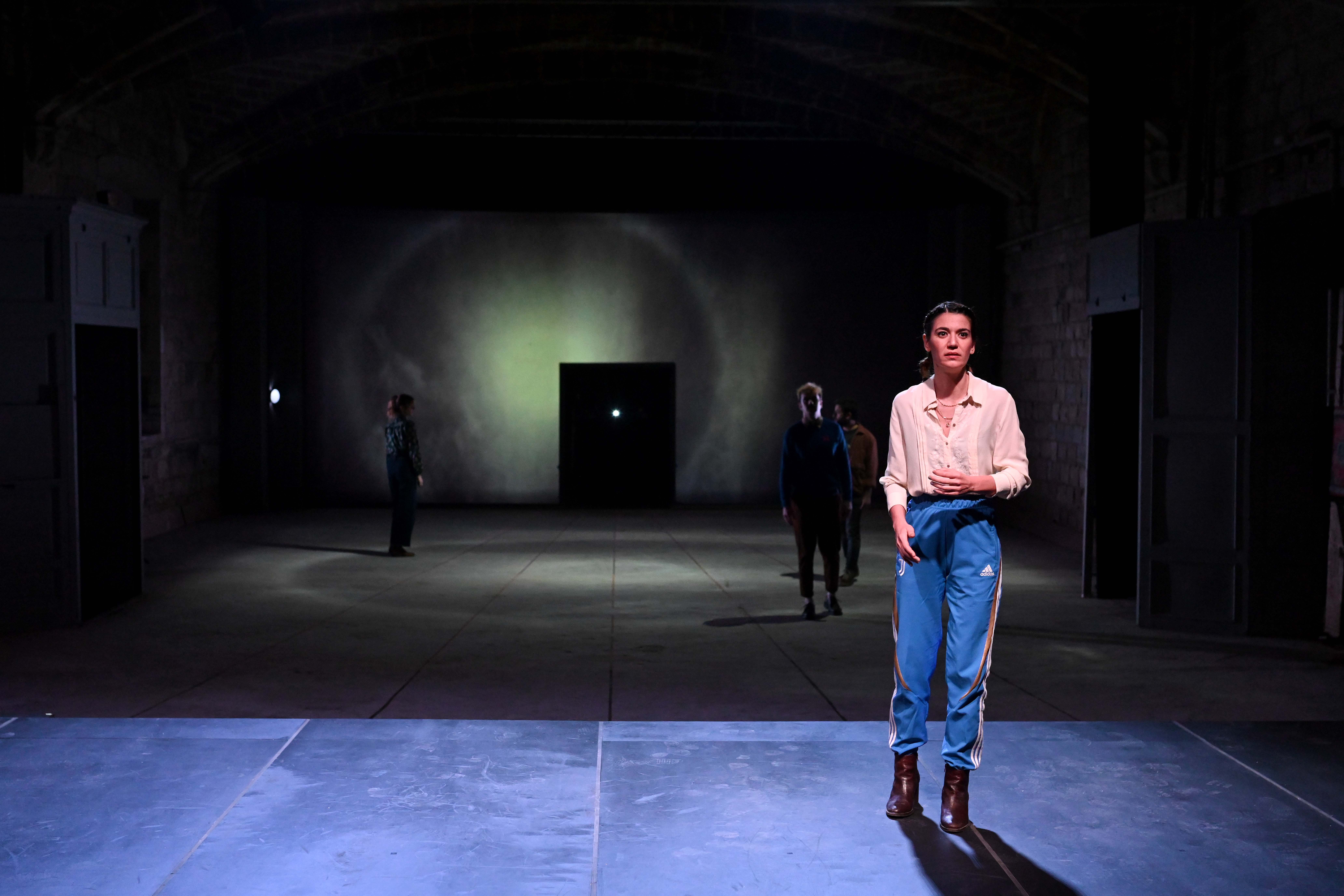
Events unfold at a remarkable pace, shifting radically within three lines of dialogue. The dramatic space of the fable and the theatrical space of the stage constantly intermingle. The stage action is mostly narrated, which presents one of the main challenges for the theatrical staging. In Stoev’s words, it’s “a talk show addressed directly to the audience” [11]. The present that unfolds dances between the dramatic present to which the actor-narrators guide us and the theatrical present of this rhapsodic act between stage and spectators. As Ferran Utzet mentioned during a rehearsal discussion, the staging resembles the old stories told around a fire, where a more or less linear tale is told and the relationship between narrator and audience shifts fluidly in and out of the fable.
“This is not an aesthetic decision, nor a formal experiment, but a necessity in finding today’s pulse. He does this in order to awaken a kind of listening and vision that are receptive to the stories he tells — stories that send us back to intimacy as shared space, beyond cultural or social criteria. And this compels us to perceive and learn differently from our unresolved or unresolvable conflicts. For a few moments, what separates us vanishes, and the encounter can take place.” [12]
We asked ourselves about the theatrical game Vyrypaev proposes to address the question of spirituality, which he defines as the principal contemporary conflict. This play uses the fable to metaphorically convey the theme, which in turn goes beyond current affairs through its form — shaking the encounter between audience and stage. Vyrypaev’s theatrical play, therefore, uses fable, theme, and form to create a collective experience of spirituality, to find its contemporary pulse. In Galin Stoev’s words, Vyrypaev “is one of the rare contemporary playwrights able to reformulate the stage-audience relationship, not through formal experimentation, but through subtle communication that seeks to bring artists and spectators into the same physical, emotional, and energetic frequency.”
Vyrypaev’s theatricality seeks a kind of collective vibration — not in the sense that the whole audience feels moved by a certain passage, but in the sense that it activates a spiritual relationship with existence. Vyrypaev himself explains: “In all my plays, I work precisely with rhythm. One must read my texts as poetry. [...] I keep telling myself that I’m not writing texts, but musical scores.” [13] Vyrypaev aims to achieve an effect similar to music, which during the course of a piece synchronises all listeners within the same rhythmic partition of space-time. This, in fact, is an old idea expressed by Adolphe Appia:
“Music [...] is not a duration in time, that is to say, a fictional duration on stage for spectators living in a different time; rather, it is time itself.” [14]
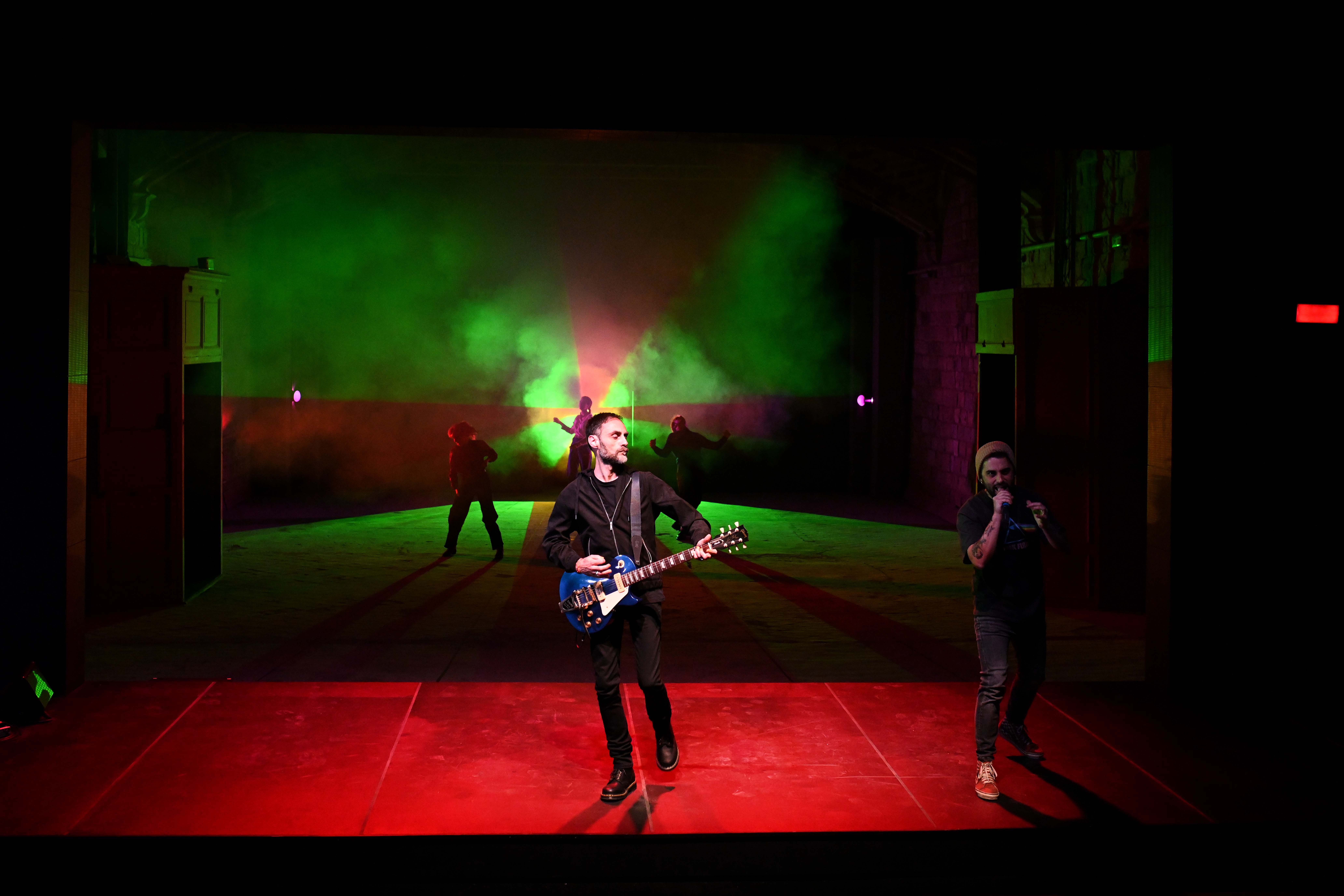
To make theatre as a theatrical score, following Vyrypaev, is to play the elements of the stage like pulses, tempos — establishing a rhythm, creating a melody, in order to bring stage and audience into synchrony. If theatre often speaks of rhythm and places it at the heart of staging, it is perhaps because, through mastering rhythm, we can create that shared state of frequency between stage and auditorium.
“Rhythm can be found in the voice, in the text, in movement, in the body, colours, lights, music, smoke. An actor’s movement is like a dance. That’s why managing rhythm is key. When I was a student, we were told that theatre is action. But now I believe that more than action, it is the rhythm of the action, or the rhythm of emotion, or the rhythm of discovery. The spectator, during the performance, must discover their own emotions and their relationship with the performance. This process of discovery, like any process, has a rhythm.” [15]
This is not simply a metaphor overused in theatrical discourse, but a principle underpinning stage creations that seek the here-and-now of theatre — this strange kind of time that suspends everyday temporality in favour of a collective one. A time that reveals the ritualistic character of theatre, its spiritual power as art — ultimately, a theatrical act that brings us into synchrony, like an embrace.

References
-
Ivan Viripàiev. Programme de Genèse n. 2. L Ed. Théâtre de la Place, Liège, Belgium, 2006, p.?22.
-
‘The authors of Novaia Drama (New Drama) are engaged in a process of deconstructing the structures of classical drama used in Russian theatres, resorting to various dramaturgical deviations and a writing style governed by montage. They have introduced significant innovations in the selection and treatment of themes, highlighting issues affecting contemporary Russian society; they have renewed the connection with the various levels of spoken language across different social strata.’ See Tania Moguilevskaia, in the introductory essay to the French version of Genèse N°2, éd. Théâtre de la Place, Liège, Belgium, 2006.
-
His personal website, where he shares his views and outlines actions related to his theatrical work, can be consulted at: https://www.vyrypaev.com/ (last accessed 31/03/2022).
-
José Gabriel López Antuñano, Ivan Viripaev, una renovación en la escritura teatral rusa, Revista de la Asociación de Investigación y Experimentación Teatral, No.?65, Barcelona, 2008.
-
Marga del Hoyo Ventura, Viripaev. El deseo de trascendencia en la existencia cotidiana: algunas notas sobre la dramaturgia, Revista Pygmalión Nos. 9–10 (2017–2018), Ed. Instituto del Teatro de Madrid, p.?172.
-
Ivan Viripàiev, in Programme de Rêves by Théâtre Alibi, 2011, p.?5.
-
Ivan Viripàiev, Unes abraçades insuportablement llargues. Trans. Miquel Cabal, 2022, unpublished script.
-
Ivan Viripàiev, in the introductory essay to the French version of Genèse N°2, éd. Théâtre de la Place, Liège, 2006.
-
Galin Stoev, in an interview with Mélanie Jouen in the quarterly magazine Revue du théâtre, Winter 2018, Ed. Théâtre de la Cité, Toulouse, p.?5.
-
Ivan Viripàiev, Unes abraçades insuportablement llargues. Trans. Miquel Cabal, 2022, unpublished script.
-
Ibid.
-
Ibid.
-
Ivan Viripàiev, in the introductory essay to the French version of Genèse N°2, éd. Théâtre de la Place, Liège, Belgique, October 2006.
-
Adolphe Appia, La música y la puesta en escena. Trans. Nathalie Cañizares. Ed. Publicaciones de la ADE, 2014, Madrid, p.?82.
-
Oriol Broggi, El record de la bellesa, L'Altra Editorial, Barcelona, 2022, pp.?32–33.

our newsletter
Do you want to become a member of #AsSocPerla? All the information here.